

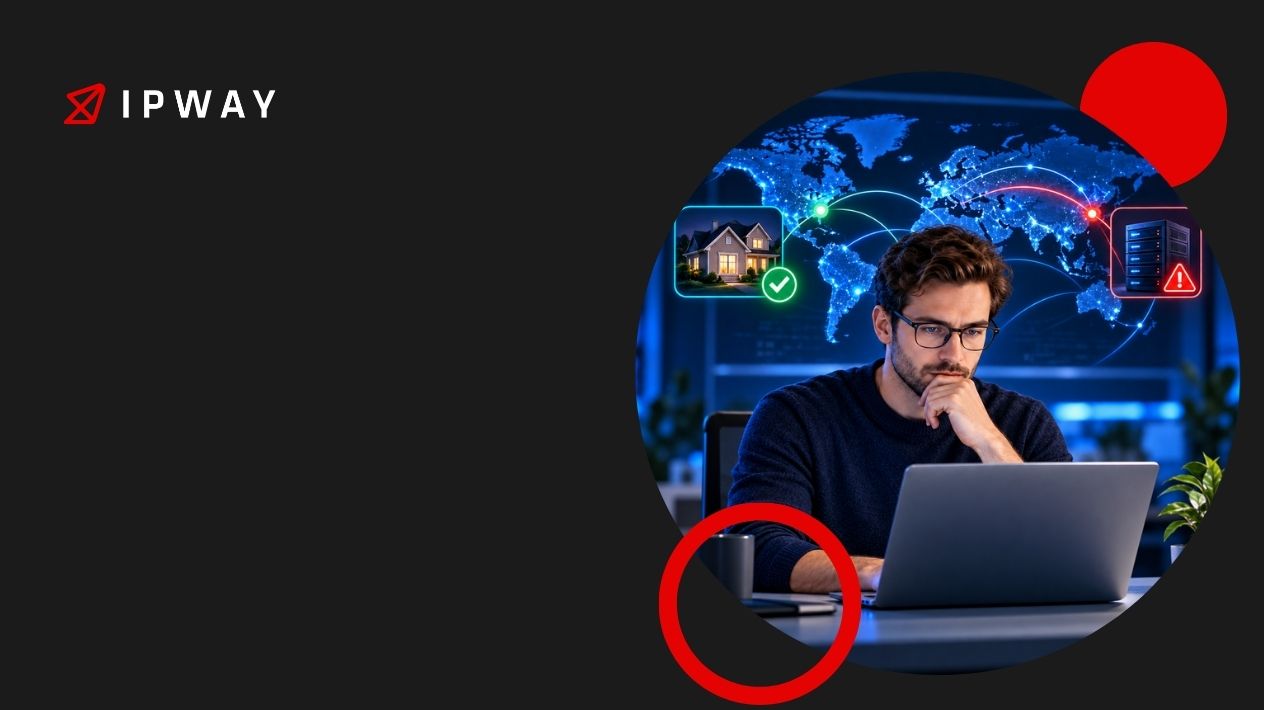
A residential IP can genuinely belong to a consumer ISP and still be identified as residential proxy traffic. That distinction has become much more important in 2026 as Cloudflare, MaxMind, IPinfo, and other IP intelligence providers expand the signals available for identifying residential proxy activity.
For proxy users, this changes a long-standing assumption. Seeing a recognizable consumer ISP or residential ASN does not automatically mean that every website will treat traffic from that IP as ordinary household browsing.
The more useful questions are now: Who operates the network? Has the IP recently been observed in a residential proxy network? What reputation does it carry? And does it actually perform as required against the intended destination?
Those are related questions, but they are not the same thing.
Key Takeaways
• The main takeaway is that residential does not mean undetectable. A genuine ISP-assigned address can still appear in residential proxy intelligence. ISP classification and proxy classification measure different properties of an IP, and different databases may legitimately return different results.
• The other major change is that these classifications are becoming more dynamic. Providers increasingly include information such as confidence, last-seen date, provider association, and activity frequency rather than relying on a permanent proxy/not-proxy label.
• Finally, an IP lookup cannot tell you exactly how a particular website will respond. Real-world testing against the same destinations, geographies, sessions, and workloads you plan to use remains the most useful measure.
- What Is Residential Proxy Detection?
- What Changed in Residential Proxy Detection in 2026?
- Residential ISP and Residential Proxy Are Not Opposites
- Why Can MaxMind, IPinfo, and Other Databases Disagree?
- Does Residential Proxy Detection Mean Residential Proxies No Longer Work?
- The IP Address Is Only One Part of the Decision
- How Should You Evaluate a Residential IP in 2026?
- “Clean Residential IP” Is Not a Complete Quality Metric
- What Should You Do If Residential Proxy Performance Drops?
- What About ISP Proxies?
- Why This Matters for IPWAY Users
- Final Takeaway
- FAQ
What Is Residential Proxy Detection?
Residential proxy detection is the process of identifying IP addresses that are being used as residential proxy exits even though the underlying addresses belong to legitimate consumer or end-user networks.
Traditional proxy detection was often easier when an address originated from a cloud provider, hosting company, or data-center ASN. Network ownership itself provided a useful clue.
Residential proxies create a different problem because the visible IP may genuinely belong to a household broadband provider, mobile carrier, or other end-user network.
The question therefore changes from: “Does this IP belong to a hosting company?”
to: “Has this residential address been observed participating in proxy activity?”
That second question is becoming increasingly measurable.
What Changed in Residential Proxy Detection in 2026?
One of the clearest developments came from Cloudflare. Its current Bot Management documentation includes a specific detection for traffic observed from residential proxy networks and similar commercial proxies. When that detection matches, Cloudflare assigns the request a lower bot score and identifies anomaly detection as the score source.
That is significant because the address does not first need to be classified as a traditional data-center proxy. A residential network and residential-proxy activity can exist at the same time.
MaxMind expanded its own residential proxy intelligence in July 2026. On July 17, it added a residential component containing a confidence score from 1 to 99, the last date a network was observed, and the associated residential proxy provider.
On August 27, MaxMind went further by adding a dedicated GeoIP Residential Proxy database to its Anonymous Plus suite. During development between May and August 2026, that database ranged from approximately 61.9 million to 67.6 million IPv4 networks and 24.9 million to 29.3 million IPv6 networks.
IPinfo has also expanded access to residential proxy intelligence. Its current dataset exposes whether an address was observed as a residential proxy, the associated service, when the IP was last seen, and how frequently it appeared during the observation period. IPinfo says its dataset has grown from roughly 47 million IPs in mid-2025 to more than 107 million in 2026, spanning 126 proxy providers.
Taken together, these developments show why simply checking whether an IP belongs to a residential ISP is no longer enough.
Residential ISP and Residential Proxy Are Not Opposites
This is probably the most important distinction for proxy users.
An ISP or ASN classification describes the network behind the address. It can tell you which autonomous system operates the IP and whether the network is associated with consumer broadband, mobile connectivity, hosting, or another type of infrastructure.
A residential proxy classification describes how that IP has been observed being used.
An address can therefore correctly return: “Residential ISP: Yes” and at the same time:
“Residential proxy activity: Yes”.
Those results do not contradict each other.
The first tells you where the IP comes from. The second tells you something about recent behavior associated with that address.
This distinction is becoming especially important because residential proxy networks often use genuine consumer connections. IPinfo, for example, says its residential proxy dataset is based on directly observed proxy activity rather than assuming an IP is a proxy simply because of its ASN or hostname.
Why Can MaxMind, IPinfo, and Other Databases Disagree?
Proxy users frequently check one IP across several services and find different answers.
One database may classify the IP as residential. Another may identify residential proxy activity. A third may show no proxy signal.
That does not necessarily mean one of them is wrong.
Different providers use different sources, observation windows, refresh schedules, methodologies, and confidence thresholds. They may also be answering different questions.
A geolocation database may primarily tell you where an IP is likely located. An ASN lookup tells you which network announces it. Privacy intelligence may ask whether it appears associated with a VPN, proxy, Tor relay, or anonymization service. Residential proxy intelligence asks whether the address has recently been observed functioning as an exit in a residential proxy network.
These are separate dimensions of IP intelligence.
IPinfo’s current residential proxy data illustrates why time matters. It exposes both a last-seen date and information about how frequently an address appeared in a proxy network.
An IP that appeared once months ago is therefore not necessarily equivalent to an IP that has been repeatedly observed in active proxy pools.
Does Residential Proxy Detection Mean Residential Proxies No Longer Work?
No. Residential proxy detection does not mean residential proxies have stopped being useful. It means that “residential” should not be treated as a guarantee of acceptance.
Residential proxy infrastructure can still be useful when an application needs consumer-network characteristics, geographic diversity, local market views, rotating IP availability, or other residential-network properties.
The important change is in how those properties should be evaluated.
Instead of asking: “Is this residential?” ask: “Does this proxy have the network characteristics and real-world performance required for this workload?”
That is a much better buying and testing question.
The IP Address Is Only One Part of the Decision
Modern traffic evaluation can include considerably more than an IP lookup.
Cloudflare’s current bot-detection documentation describes multiple detection engines using heuristics, machine learning, JavaScript detections, fingerprints, headers, browser-related characteristics, and session information.
This means a website may evaluate the network behind the request while also considering how the client and session behave.
An IP may have the correct country and residential ASN but still fail for reasons unrelated to the address itself. Request volume may be too high. The session may repeatedly restart. The browser or application may behave unexpectedly. The destination may have introduced new access restrictions.
This is why simply replacing the IP does not solve every proxy-related failure.
An IP problem should be diagnosed at the IP layer. A rate-limit, session, application, authentication, or access-policy problem may require a different solution.
How Should You Evaluate a Residential IP in 2026?
Start by checking the underlying network. Confirm the ASN, ISP, and expected network type. If your use case specifically requires ISP-associated or residential infrastructure, make sure the address actually belongs to the network category you expect.
Then check residential proxy intelligence separately. Do not assume that a consumer ISP automatically means the address has never been associated with a proxy service.
Next, verify geolocation. An IP can have good network characteristics but still be unsuitable if your application expects New York and several databases place it somewhere else. For location-sensitive SEO monitoring, e-commerce research, ad verification, or localization, compare the geolocation returned by more than one source.
Reputation should also be evaluated independently. Proxy classification and reputation are not identical. An address can appear in residential proxy intelligence without necessarily carrying the same abuse history as another address.
Finally, run representative application tests.
That means using the same destinations, locations, session lengths, traffic patterns, and concurrency levels you expect in production. A database classification is useful for screening, but only the target can tell you how that target actually treats the traffic.
“Clean Residential IP” Is Not a Complete Quality Metric
Terms such as clean, premium, and high-quality residential IP are common in proxy marketing, but none of them provides a complete technical description.
A more useful assessment considers the ASN, geolocation, recent proxy classification, reputation, session stability, retry behavior, and final result quality together.
This matters because a technically successful connection may still produce unusable data.
A response might come from the wrong location. It may contain incomplete information. It may require repeated retries. Or the session may fail before the workflow finishes.
For production proxy users, the real question is not simply whether the IP connects.
It is: “Does the IP consistently produce the result the application actually needs?”
What Should You Do If Residential Proxy Performance Drops?
When a residential proxy workflow suddenly starts failing more often, avoid assuming immediately that the solution is simply “more IPs.”
First determine whether the change is happening at the network layer. Check whether the IP is now classified differently, whether its reputation has changed, whether the ASN is still correct, and whether its geolocation remains where you expect it to be.
Then check the application. Has concurrency increased? Has a browser version changed? Are sessions restarting? Have headers, cookies, or authentication behavior changed?
Finally, check the target itself. A destination may have introduced new rate limits, access requirements, API rules, or other policies.
This troubleshooting order helps avoid treating every access issue as a proxy-quality problem.
What About ISP Proxies?
ISP proxies, often called static residential proxies, generally combine ISP-associated addresses with the stability of dedicated or more persistent proxy infrastructure.
They can be useful when a workload needs a consistent IP, longer sessions, stable network identity, or more predictable performance than a large rotating residential pool.
ISP association does not guarantee universal destination acceptance.
Network type is one input. Actual performance against the intended workload remains the final test.
IPWAY’s existing guide, How to Decide If ISP Proxies Are Worth It for You in 2026, makes the same broader point: ISP proxies make the most sense when their stability, reputation, and session characteristics improve the economics and reliability of the specific workload.
Why This Matters for IPWAY Users
IPWAY provides rotating and dedicated ISP residential proxy options as well as residential proxy API infrastructure. Its current platform supports both usage-based and dedicated-IP models, allowing teams to choose between rotating access and more persistent IP configurations depending on their workload.
But selecting the proxy type is only the beginning.
Proxy infrastructure should be evaluated against what the application needs to accomplish. For one team, geographic accuracy may be the most important metric. For another, session stability or cost per usable result may matter more.
This is also why representative testing matters more than relying only on pool size, price per GB, or a residential label. IPWAY’s own proxy-buying guidance recommends evaluating factors such as IP quality, pool freshness, geotargeting, sticky sessions, pricing, support, and sourcing against the actual workflow.
Test With Your Real Workload
The most useful proxy benchmark is your own production scenario.
Start your IPWAY 7-day free trial and test proxy performance with the targets, locations, and applications you actually use before you scale.

Final Takeaway
The biggest development in residential proxy detection in 2026 is not that residential proxies suddenly became detectable.
It is that residential proxy activity is becoming a more explicit, measurable, and time-sensitive category of IP intelligence.
Cloudflare now documents residential-proxy detection within its bot-management system. MaxMind introduced residential proxy confidence, provider, and last-seen data and launched a dedicated residential proxy database. IPinfo exposes recent activity and frequency information and says its dataset now tracks more than 100 million residential proxy IPs.
For proxy users, this means “residential” should be treated as one characteristic of an IP, not the final quality test.
The better question is:
Does this IP have the network characteristics, location, reputation, session performance, and real-world results that our application requires?
That is what meaningful proxy testing should answer.
FAQ
Can a residential IP be detected as a proxy?
Yes. An IP can genuinely belong to a residential ISP and still be identified as participating in a residential proxy network. Residential network ownership and residential proxy activity are different classifications.
How are residential proxies detected?
Detection methods vary by provider. They can include directly observed proxy-network participation, IP intelligence, ASN data, reputation, browser and client signals, fingerprints, session behavior, and request patterns. No single method is used universally.
Does a residential ISP name mean the IP is not a proxy?
No. The ISP tells you which network is associated with the address. Residential proxy intelligence can separately indicate that the same IP has been observed functioning as a proxy exit.
Why do MaxMind and IPinfo sometimes give different results?
They use different datasets, methodologies, observation windows, update schedules, and confidence systems. They may also be reporting different properties, such as network ownership, geolocation, anonymization, or recent residential proxy activity.
Is being detected as a residential proxy the same as being blacklisted?
No. Proxy classification and reputation are different concepts. An IP may be recognized as residential proxy traffic without necessarily carrying the same abuse or blacklist history as another address.
Are ISP proxies detectable too?
Potentially. An ISP-associated address does not guarantee that a website or IP intelligence service will classify every request as ordinary household traffic. The final decision can depend on multiple network and application signals.
Are residential proxies still useful in 2026?
Yes. Residential proxies remain useful for legitimate applications that need residential-network characteristics, geographic diversity, localized access, or rotating addresses. Their suitability should be verified against the real workload rather than assumed from the proxy label alone.
How should I test a residential proxy provider?
Test the same destinations, locations, session lengths, traffic levels, and applications you expect to use in production. Evaluate whether the infrastructure produces accurate, stable, usable results rather than testing only whether the proxy connects.
Disclaimer: This content is provided for general informational purposes only and does not constitute legal advice. Proxy infrastructure and automated data collection should be used only for lawful, authorized, and responsible purposes. Users are responsible for complying with applicable laws, privacy requirements, contractual obligations, website terms, official API rules, and access policies. Proxy classifications, reputation data, geolocation, and destination acceptance can vary between providers, databases, websites, and over time.