

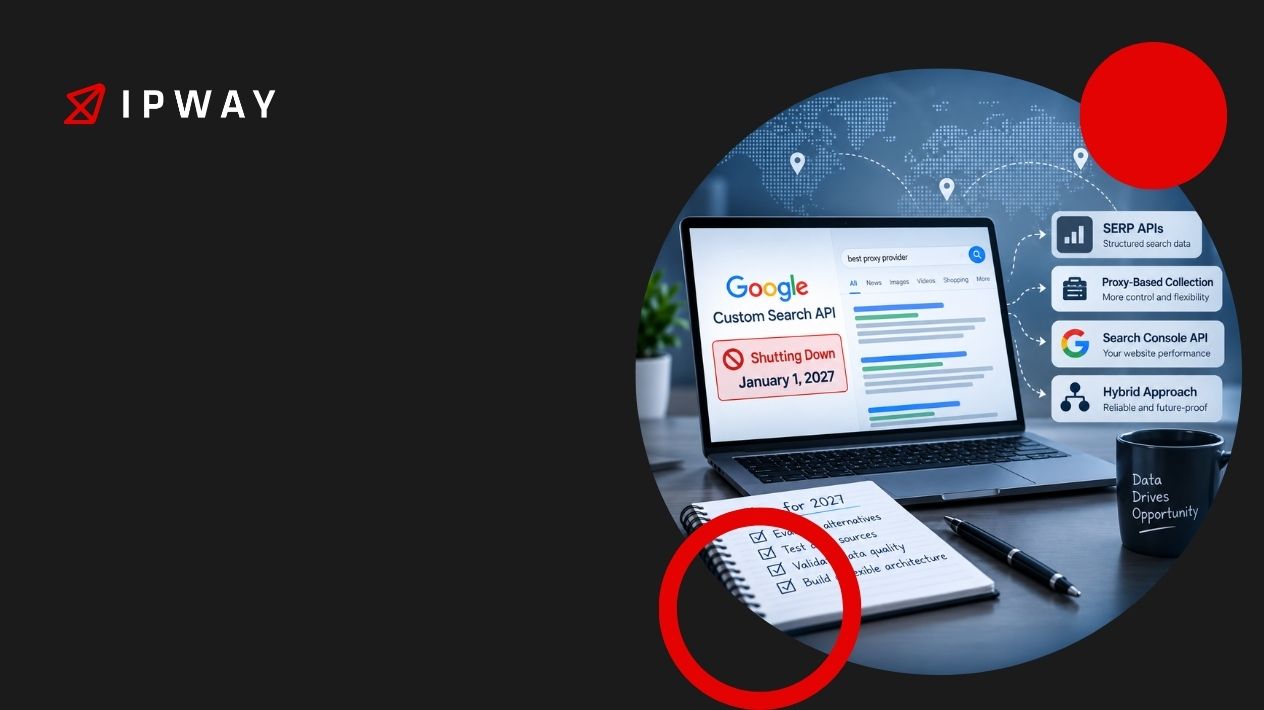
If you are looking for a Google Custom Search API alternative, the decision is no longer just about replacing one endpoint with another.
Google says the Custom Search JSON API is closed to new customers, and existing customers have until January 1, 2027 to migrate. Microsoft has already retired its Bing Search APIs.
For SEO platforms, rank trackers, market-intelligence teams, AI applications, and businesses monitoring localized search results, this creates a broader infrastructure question:
Where should your SERP data come from, how will you verify it, and how easily can you change sources when the next API or search interface changes?
Key Takeaways
• Google Custom Search JSON API access for existing customers ends January 1, 2027.
• Microsoft retired the Bing Search APIs on August 11, 2025.
• Google Search Console API remains useful, but it reports performance for properties you control rather than providing a general competitor SERP feed.
• Businesses should separate SERP collection from downstream analytics so the underlying source can be changed without rebuilding the product.
• Data correctness, freshness, geographic accuracy, and SERP-feature coverage matter as much as request success.
• Proxy infrastructure is one option for authorized SERP-data workflows, but it introduces engineering, compliance, monitoring, and cost responsibilities.
• The most resilient approach is often a provider-independent data layer with continuous validation and more than one tested collection path.
- • Google Custom Search JSON API Is Going Away
- • Four Ways Businesses Can Get Search Data After the Change
- • Build a SERP Data Adapter Before You Need One
- • Validate SERP Data With Canary Queries
- • Measure SERP Infrastructure by Business Output
- • Does Proxy Type Matter for SERP Monitoring?
- • What Should Teams Do Before January 1, 2027?
- • Build for the Next Search Change, Not Just This One
- • FAQ about Google Custom Search API alternative
Google Custom Search JSON API Is Going Away
This part is not speculation.
Google’s current developer documentation states that the Custom Search JSON API is closed to new customers. Existing customers can continue using it only until January 1, 2027.
Google currently recommends Vertex AI Search for use cases involving search across up to 50 domains and asks organizations requiring broader web search to contact Google about its full-web-search offering. Existing Custom Search customers still receive 100 free queries per day, with additional requests priced at $5 per 1,000 queries and a 10,000-query daily limit until discontinuation.
This follows another important change in the search-data market. Microsoft retired its Bing Search APIs on August 11, 2025, decommissioning existing instances and directing customers toward Grounding with Bing Search in Azure AI.
The result is a shrinking set of traditional self-service search APIs at exactly the same time that SEO systems, AI agents, competitive-intelligence platforms, and analytics applications need more current search data.
The Bigger Problem Is Dependency, Not the API Shutdown
An API disappearing creates an obvious failure.
Your request stops working, monitoring fires, and engineering knows something broke.
A harder problem is when the pipeline continues returning results but their meaning changes.
One discussion this week described a team discovering that a paid search-data source was returning plausible-looking results that did not match expected Bing results. That is a single community anecdote and cannot be generalized to SERP providers as a whole, but the operational lesson is important: a technically successful response is not the same as trustworthy search data.
The same principle applies to proxy-based SERP monitoring.
A request can return 200 OK while the result is incomplete, localized incorrectly, stale, challenged, or structurally different from what your parser expects.
IPWAY’s guide on how to test a proxy provider before buying makes the same distinction for proxy testing: evaluate valid results rather than connectivity alone.
For SERP data, that means your monitoring system needs to validate the answer, not just the HTTP request.
Four Ways Businesses Can Get Search Data After the Change
There is no single replacement because different sources solve different problems.
1. Google Search Console API for Your Own Website
If the goal is understanding how a property you control performs in Google Search, the Search Console API should be part of the stack.
Google’s Search Analytics API exposes metrics including queries, pages, countries, devices, clicks, impressions, CTR, and average position for properties available in your Search Console account.
That makes it valuable for first-party SEO analysis.
It does not replace independent SERP monitoring when you need to answer questions such as:
Which competitor ranks first in Dallas?
Which domains appear for the same keyword in Germany and the United States?
Does a particular SERP contain a local pack or another search feature?
Those require a different data source.
2. Third-Party SERP APIs
A SERP API moves collection, parsing, infrastructure, and often geographic targeting to another provider.
For many businesses, this is attractive because engineers can request structured results rather than maintaining browser automation and search-result parsers.
The tradeoff is dependency.
Before treating a SERP API as infrastructure, ask where the underlying data comes from, how often it is refreshed, which locations and devices are supported, which SERP features are returned, and what happens if the provider’s own upstream source changes.
You are outsourcing operational complexity, not eliminating it.
3. Authorized In-House SERP Collection
Some organizations build their own search-monitoring layer because they need precise control over geography, scheduling, raw HTML, validation, or downstream parsing.
This is where proxies can become part of the architecture.
For example, businesses conducting permitted localization testing or search-market research may need controlled IP locations so they can compare what a search experience looks like in different markets.
The important distinction is that the proxy solves the network-location layer. It does not solve parsing, browser maintenance, rate controls, data validation, compliance, or changing page structures.
Teams considering this model should also read IPWAY’s guide to why rotating proxies still get blocked. Modern traffic controls evaluate much more than the IP address, so adding more rotation is not a substitute for a responsible collection architecture.
4. A Hybrid SERP Data Layer
For business-critical SEO systems, the most resilient model may be a combination.
Search Console can provide first-party performance.
A commercial SERP API can provide normalized external rankings.
An authorized internal collection process may cover specific geographies, quality checks, or workflows where raw results are required.
The important architecture decision is to normalize all of these behind your own internal interface.
Your reporting system should not care whether a ranking came from Provider A, Provider B, or an approved internal collector. It should receive a consistent record containing the keyword, market, device, timestamp, ranking position, URL, result type, and data source.
That makes the next migration much less painful.
Build a SERP Data Adapter Before You Need One
One of the strongest ideas appearing in this week’s discussions was also one of the simplest: do not tightly couple your application to one search provider.
A practical internal SERP record might contain:
| Field | Why it matters |
|---|---|
| Query | Identifies the search being measured |
| Country / region | Prevents geo results from being mixed |
| Device | Separates desktop and mobile observations |
| Timestamp | Lets you detect stale data |
| Rank | Core monitoring metric |
| Destination URL | Needed for page-level tracking |
| Result type | Organic, local, image, other supported feature |
| Source | Identifies the API or collection method |
| Validation state | Shows whether the record passed quality checks |
Your business logic consumes this schema.
The data-source adapter converts whatever each provider returns into that format.
Changing providers then becomes a mapping exercise instead of a product rewrite.
This is similar to the principle behind IPWAY’s guide to cloud-friendly proxy architecture: networking, credentials, retries, observability, and proxy selection work better as shared infrastructure than when they are hardcoded into every individual job.
Validate SERP Data With Canary Queries
Migration planning should include something many teams overlook: known-good tests.
Choose a controlled set of queries for which your team regularly checks the live result manually or through another trusted source.
Then compare your production feed against those canaries.
Track changes in ranking positions, returned URLs, location, language, result count, unexpected empty fields, and timestamp freshness.
A provider outage is easy to see.
A feed that continues delivering plausible but incorrect data is much harder.
This is especially important because automation now represents an unusually large share of web activity. Thales’ 2026 Bad Bot Report, based on full-year 2025 data, says bots represented 53% of global web traffic, while bad bots accounted for 40%. The company also reported that 27% of bot attacks targeted APIs. These statistics cover the broader web and should not be interpreted as evidence that legitimate SEO monitoring is malicious. They do help explain why web platforms increasingly invest in stricter automation controls.
Measure SERP Infrastructure by Business Output
Do not compare search-data options only by price per request.
For SEO and market-intelligence teams, better metrics include cost per validated keyword, geographic accuracy, result freshness, p95 collection time, missing-result rate, SERP-feature completeness, retry rate, and engineering hours spent maintaining the collection layer.
A cheap feed that silently returns stale rankings can be much more expensive than a higher-priced source that produces reliable data.
Likewise, an internal proxy-based collector can look inexpensive when the only line item is bandwidth. Once browser infrastructure, parser maintenance, retries, monitoring, compute, and engineering time are added, the calculation changes.
IPWAY covers this same cost principle in its guide to reducing proxy costs without hurting scraping success: the useful metric is cost per successful result, not simply cost per GB.
Does Proxy Type Matter for SERP Monitoring?
Yes, but there is no universally best proxy type.
Datacenter proxies can be efficient for authorized, high-volume monitoring where they perform reliably.
ISP proxies can make sense when a workflow requires stable geographic identity or when datacenter traffic produces inconsistent results.
Rotating proxies are useful for independent requests, but constant rotation is not automatically better.
The correct decision should come from testing.
Compare the same keywords, locations, schedules, and validation rules across proxy types. Measure valid-result rate, latency, geographic consistency, retries, and total cost.
IPWAY’s guide to deciding whether ISP proxies are worth it provides a useful framework for making that comparison.
What Should Teams Do Before January 1, 2027?
Teams still dependent on Custom Search JSON API should not wait until December.
First, document every application, dashboard, agent, scheduled task, or customer feature that uses the API.
Next, define exactly what data each workload actually requires. A rank tracker needs something different from an AI research agent.
Then create a provider-independent schema and test at least one alternative source.
For existing Custom Search users, run the current and replacement source side by side long enough to establish differences in coverage, latency, geography, cost, and data quality.
Finally, decide how your system will detect bad data after migration.
The goal is not merely to survive January 1.
It is to avoid being in the same position the next time a search-data source changes.
Build for the Next Search Change, Not Just This One
The January 2027 Custom Search deadline is a useful forcing function.
Businesses that depend on SERP data now have an opportunity to separate search collection from the rest of their analytics stack, establish proper data-quality checks, and measure the real cost of every collection method.
For teams that need proxy infrastructure for legitimate SEO monitoring, localized search research, QA, or public-web-data workflows, IPWAY lets you test datacenter and ISP proxy options against your own workload before deciding how to scale.

FAQ about Google Custom Search API alternative
When does the Google Custom Search JSON API shut down?
Google states that existing customers have until January 1, 2027 to transition to another solution. The API is already closed to new customers.
What is the best Google Custom Search API alternative?
There is no universal replacement. Search Console works for first-party website performance, commercial SERP APIs provide structured external search results, and authorized internal collection can provide greater control. The best option depends on your data requirements, geography, scale, compliance needs, and operating budget.
Can Google Search Console API replace a SERP API?
Not completely. Search Console provides search-performance data for properties available in your account. It does not provide a general-purpose competitor SERP feed.
Do I need proxies for SERP monitoring?
Not always. Some teams use commercial SERP APIs and never manage proxies directly. Proxies become relevant when an authorized internal workflow needs controlled geographic access, network separation, or specific routing characteristics.
Which proxies are best for SERP scraping?
It depends on the target, geography, request volume, and required stability. Datacenter proxies may be sufficient for some workloads, while ISP proxies can be useful where stable network identity or different reputation characteristics improve results. Test against the real workload rather than assuming one proxy type is always better.
What should I measure when comparing SERP data providers?
Measure validated-result rate, freshness, geographic accuracy, device accuracy, ranking consistency, SERP-feature coverage, latency, missing fields, retry volume, engineering effort, and cost per usable result.
How can I avoid SERP-provider lock-in?
Put an internal normalization layer between the data source and your application. Standardize fields such as query, location, device, timestamp, rank, URL, result type, provider, and validation status.
Why should SERP data be validated if the API returns successfully?
Because a successful API or HTTP response only confirms that a request completed. It does not prove that the data is fresh, correctly localized, complete, or consistent with the search experience you intended to measure.
Responsible-Use Disclaimer
This article is provided for general informational purposes and does not constitute legal or compliance advice. Search engines, websites, and APIs may impose contractual terms, rate limits, access policies, robots directives, and technical restrictions. Organizations should review applicable laws, platform terms, privacy requirements, intellectual-property obligations, and official APIs before automating access. Proxies should be used only for lawful and authorized purposes and should not be used to bypass authentication, CAPTCHAs, paywalls, explicit access controls, or other security measures without authorization.